John Mullins
John is an Oracle Instructor, DBA, and Developer with more than 25 years of Oracle experience. His credentials include the Oracle Certified Professional DBA and Certified Technical Trainer certifications.
Are You Ready For ITIL 5?
Best Accredited ITIL Foundation Courses
Best Accredited ITIL Managing Professional Courses
Best Accredited ITIL Managing Professional Transition Course
Best Accredited ITIL Practice Manager Courses
Best Accredited ITIL Strategic Leader Courses
Best Accredited ITIL Transformation Course
Best ITIL Test Prep
Best PeopleCert Support Videos
IT Asset Management
ITIL 4 Foundation - PeopleCert Accredited
ITIL 4 Managing Professional – PeopleCert Accredited
ITIL 4 Practice Manager – PeopleCert Accredited
ITIL 4 Specialist: Collaborate Assure and Improve
ITIL 4 Specialist: Monitor Support & Fulfil
ITIL 4 Specialist: Plan Implement and Control
ITIL 4 Strategic Leader – PeopleCert Accredited
Lean Six Sigma
There are many things that can affect the quality of your video so we have put together these instructions to help you review all the things that need to be tested in order to trouble-shoot video quality.
The first thing we want to assure you is that we have done everything possible to make sure that our videos will play well. Our videos are hosted in the cloud by Akamai. Akamai has servers around the world to make sure that your videos are sent from the server that is closest to you. By hosting our videos with Akamai we make sure that you receive the highest video quality. If you are experiencing video buffering or freezing at home or at the office there are a number of things you can do to help us troubleshoot.
John is an Oracle Instructor, DBA, and Developer with more than 25 years of Oracle experience. His credentials include the Oracle Certified Professional DBA and Certified Technical Trainer certifications.
Hardware:
Software:
This course is designed to use Oracle 11g editions below but will also support 12c. Set up guides for both versions are included with the course.
These links are activated when you purchase this course.
This course comes with a Transcript that tracks your progress. You can use your transcript to view and monitor your progress and when you complete the course, you can print or email the transcript.
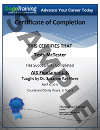
You will be awarded a Letter of Course Attendance when you finish this course. You will be able to print or email the Letter of Attendance and share your accomplishment with everyone.
Oracle 11g/12c Introduction to SQL combined with Oracle 11g/12c Advanced SQL helps you to prepare for any of the following exams: 1Z0-047 Oracle Database SQL Expert or 1Z0-051 Oracle Database 11g: SQL Fundamentals I or 1Z0-061 Oracle Database 12c: SQL Fundamentals. When you pass one of the 1Z0-051 or 1Z0-061 exams, you have completed a portion of the requirements towards one of several Oracle’s Certified Associate (OCA) certifications. Passing the 1Z0-047 exam gives you the Oracle Database SQL Certified Expert certification.
For more information about certification, requirements and fees, click on the link found in Related Links.
The following certification prep books provide further help including valuable practice exams. Combining a hands-on course with practice exams is highly recommended to prepare for Oracle’s various certifications.
OCA Oracle Database SQL Certified Expert Exam Guide (Exam 1Z0-047)
by Steve O'Hearn ISBN-13: 978-0071614214 ISBN-10: 9780071614214
OCA Oracle Database 11g SQL Fundamentals I Exam Guide Exam (1Z0-051)
by John Watson ISBN-13: 978-0071597869 ISBN-10: 9780071597869
OCA Oracle Database 12c SQL Fundamentals I Exam Guide (Exam 1Z0-061)
by Roopesh Ramklass ISBN-13: 978-0071820288 ISBN-10: 0071820280
In this course, students learn how to use the advanced features of SQL in order to query and manipulate data within the database. Advanced querying and reporting techniques including using SET operators, writing hierarchical queries and using the Flashback Query feature are explained. Schema objects such as Tables, Indexes and Constraints are discussed in detail.
In order to take this course you need to have taken Oracle 11g/12c: Introduction to SQL and have experience in writing Oracle SQL statements.
You need to have equivalent experience or have taken the following GogoTraining courses:
Module 00: Oracle 11g/12c: Advanced SQL Online Training - Course Introduction
Module 01: Using the Set Operators
• Use the UNION operator to return all rows from multiple tables and eliminate any duplicate rows
• Use the UNION ALL operator to return all rows from multiple tables (with duplicates)
• Describe and use the INTERSECT operator
• Explain and use the MINUS operator
• List the SET operator guidelines
• Order results when using the UNION operator
• Using the ORDER BY clause with SET operators
• Lab Exercise
Module 02: Using the Set Operators Demo
Module 03: Flashback Query
• Prerequisites for using the Flashback Query feature
• Uses for the Flashback Query feature
• Limitations of the Flashback Query feature
• Statement level vs. session level usage
• Using statement level Flashback Query
• The AS OF TIMESTAMP option
• Using session level Flashback Query
• The DBMS_FLASHBACK Oracle supplied package
• Lab Exercise
Module 04: Flashback Query Demo
Module 05: Using Subqueries
• Use a subquery to solve a problem
• Identify where subqueries can be placed in a SELECT statement
• Describe the types of subqueries (single row, multiple row)
• The single row subquery operators
• The multiple row subquery operators
• Using multi-column subqueries
• Writing a correlated subquery
• Lab Exercise
Module 06: Using Subqueries Demo
Module 07: Hierarchical Retrieval
• Hierarchical Queries
• Ranking Rows with LEVEL
• Formatting Hierarchical Reports Using LEVEL and LPAD
• Pruning Branches with the WHERE and CONNECT BY clauses
• Lab Exercise
Module 08: Hierarchical Retrieval Demo
Module 09: Using the Data Dictionary Views
• Types of Data Dictionary Views
• Privileges needed to access the Data Dictionary Views
• Using the Data Dictionary Views to view database metadata information
• Helpful Data Dictionary Views
• Lab Exercise
Module 10: Using the Data Dictionary Views Demo
Module 11: Creating Database Objects I (Views)
• Creating a view syntax
• View options
• Privileges needed to create a view
• Benefits of views
• Limitations of views
• Using views in SQL statements
• Retrieving View definitions from the Data Dictionary
• Lab Exercise
Module 12: Creating Database Objects I (Views) Demos
Module 13: Creating Database Objects II (Sequences)
• Creating a sequence syntax
• Privileges needed to create a sequence
• Sequence usage
• Sequence options
• Using sequences in SQL statements
• Retrieving Sequence definitions from the Data Dictionary
• Lab Exercise
Module 14: Creating Database Objects II (Sequences) Demo
Module 15: Creating Database Objects III (Synonyms)
• Types of synonyms
• Private vs. Public synonyms
• Creating a synonym syntax
• Privileges needed to create a synonym
• Synonym usage
• Using synonyms in SQL statements
• Retrieving Synonym definitions from the Data Dictionary
• Lab Exercise
Module 16: Creating Database Objects III (Synonyms) Demo
Module 17: Creating Database Objects IV (Tables)
• Types of Tables
• The Basic Heap Table
• Creating a table syntax
• Valid column datatypes
• Privileges needed to create a table
• Retrieving Table definitions from the Data Dictionary
• Lab Exercise
Module 18: Creating Database Objects IV (Tables) Demo
Module 19: Creating Database Objects V (Indexes)
• Types of Indexes
• Benefits of Indexes
• The B-Tree Index
• Creating an index syntax
• Privileges needed to create a index
• Retrieving Index definitions from the Data Dictionary
• Lab Exercise
Module 20: Creating Database Objects V (Indexes) Demo
Module 21: Creating Database Objects VI (Constraints)
• Types of Constraints
• Primary Key, Foreign Key, Unique, NOT NULL, Check constraints
• Review constraint purposes
• Creating a constraint syntax
• CREATE vs. ALTER syntax
• Retrieving Constraint definitions from the Data Dictionary
• Lab Exercise
Module 22: Creating Database Objects VI (Constraints) Demo
Module 23: Regular Expression Support
• Regular Expression Support Overview
• Describing simple patterns for searching and manipulating data
• Describing complex patterns for searching and manipulating data
• Lab Exercise
Module 24: Regular Expression Support Demo
Module 25: Advanced Oracle: 12c New Features
• Row Pattern Matching
• A Sequence Change
• Invisible Columns
• Data Type Changes
• UNION/UNION All Changes
Oracle 11g/12c Introduction to SQL combined with Oracle 11g/12c Advanced SQL helps you to prepare for any of the following exams: 1Z0-047 Oracle Database SQL Expert or 1Z0-051 Oracle Database 11g: SQL Fundamentals I or 1Z0-061 Oracle Database 12c: SQL Fundamentals. When you pass one of the 1Z0-051 or 1Z0-061 exams, you have completed a portion of the requirements towards one of several Oracle’s Certified Associate (OCA) certifications. Passing the 1Z0-047 exam gives you the Oracle Database SQL Certified Expert certification.
For more information about certification, requirements and fees, click on the link found in Related Links.
The following certification prep books provide further help including valuable practice exams. Combining a hands-on course with practice exams is highly recommended to prepare for Oracle’s various certifications.
OCA Oracle Database SQL Certified Expert Exam Guide (Exam 1Z0-047)
by Steve O'Hearn ISBN-13: 978-0071614214 ISBN-10: 9780071614214
OCA Oracle Database 11g SQL Fundamentals I Exam Guide Exam (1Z0-051)
by John Watson ISBN-13: 978-0071597869 ISBN-10: 9780071597869
OCA Oracle Database 12c SQL Fundamentals I Exam Guide (Exam 1Z0-061)
by Roopesh Ramklass ISBN-13: 978-0071820288 ISBN-10: 0071820280