By Jim Ragle
When preparing to take an IT-related certification exam, one needs to decide whether to self-study using free content found online or to pay for an accredited, on-demand training course specifically designed to prepare you for the relevant certification exam.
I’ve had to make this choice several times. And while I like to think of myself as resourceful and adept at filtering through online nonsense to find the good stuff, when it comes to certification exam prep it’s not worth the effort and risk to go it alone with free online content.
Choose the accredited training. You’ll get certified much easier and faster. Why?
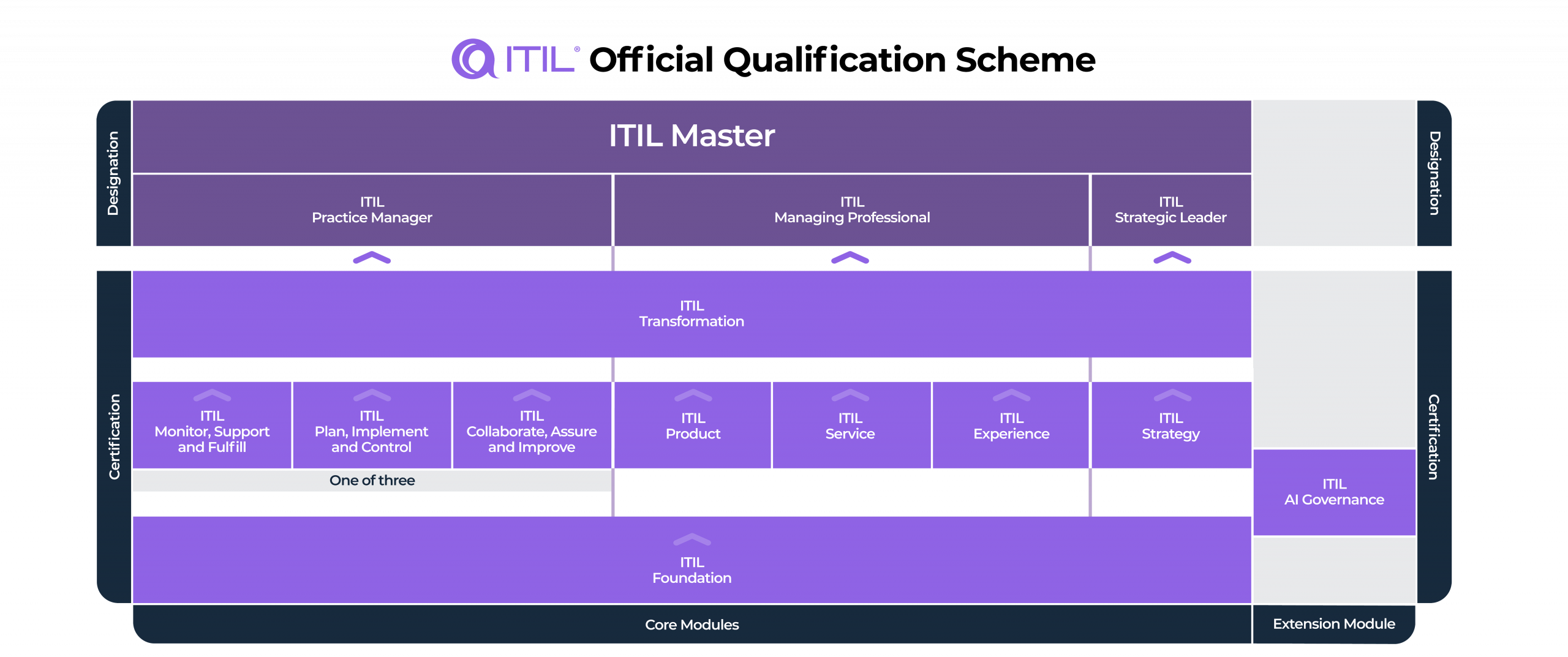
First, let’s talk about the certification program content – the stuff that you will be tested on. For most certification programs, that content is copyrighted by the owner of the certification program. ITIL certification content, for example, is developed and maintained by Axelos, which is owned by PeopleCert. Axelos/PeopleCert protect their copyright, as any commercial company developing content would do. They make money by licensing that content to accredited training organizations and selling the certification (via an exam) to would-be practitioners like us. As such, non-accredited training programs that do not license the ITIL content from Axelos/PeopleCert are prohibited from using the copyrighted content in their training offerings.
So, how can a free, unaccredited ITIL training program do a good job of training you for the exam if they aren’t allowed to share with you the copyrighted ITIL principles, practices, and methodologies?
One way they try to get around this is to simply provide free (or even paid) “practice exams” or sets of test questions you can review. Just test questions and answers – no theory, no context, nothing taken from the copyrighted material (or not enough to raise any copyright issues). I’ve seen plenty of these free exam prep questions and they are often terribly written. Here are some issues I’ve repeatedly seen in free exam prep questions:
- Only basic knowledge of English grammar is needed to select the right answer. The question asks you to select the “action” that is most important in….whatever. Of the four answer choices, only one of them (the right answer) is an action. The other choices are simply not actions at all. Trust me, your actual certification exam will NOT pull this trick on you.
- Only a basic ability to count is needed to select the right answer. The question asks you to select the three elements of…whatever. Each available choice is a list of items, but only one of the choices lists three things. Again, you won’t see anything sloppy like this on a certification exam.
- Harder to spot are just wrong answers, where the available choices don’t contain the correct answer or the answer marked as correct is, in fact, not the correct one. If you’ve not been exposed to the program content through training, how would you know that the answer is not D, but is actually C? You are putting blind trust in these free test questions.
- Also hard to spot are questions that are simply irrelevant, off-topic, and thus highly unlikely to be on the exam. Again, if you’ve not been trained, how would you even know that the question was irrelevant? Why waste your time on this?
I’m not saying all the free exam prep content out there is bad. It probably isn’t. But how do you know if it’s good or bad if you don’t know the subject matter? After all, you are admittedly a beginner if you are seeking a training course in ITIL Foundation V4, for example.
- As a beginner, can you spot training content that is wrong, misleading, or irrelevant and thus highly likely to not be on the test?
- Can you spot test questions that don’t include the correct answer in the available choices? How would you know?
If you have a lot of time and are willing to wade through an abundance of ad-supported sites offering free sample test questions and can spot the red-flag test questions as described earlier, then maybe it will work for you. However, you still have to pay for the certification exam, and there is a risk that you fail the exam and have to pay to retake it. Are you willing to take that risk?
I’d rather pay for an accredited training program and save the time, hassle, and significantly reduce the risk of failing the test. What you get when you select an accredited training program is the following:
- Actual content from the certification owner’s materials, which is what the test will be based upon.
- If the training program is specifically for certification exam prep, then it will be targeted to exactly what will be on the exam, nothing less, not much more.
- If the training program is good, it will likely be developed and presented by someone who is expert in the field and who can provide context, real-world anecdotes, and other supplementary information to help build a fuller understanding of the content, but still within the bounds of what will be covered on the exam. This never hurts, as the test questions can and do change and sometimes they are situational and require more than just memorizing definitions.
- In addition to training content, good training programs include practice quizzes and practice tests, to help you gauge whether you are assimilating the content well enough to tackle the certification exam.
When I was preparing to take the ITIL Foundation V4 exam, I reviewed some of the free content (mostly free mini quizzes) and quickly realized this was a minefield. After some research into accredited training programs, I chose the ITIL Foundation V4 training program offered by GogoTraining. The course is structured as a series of modules (all on-demand) that include video presentations with accompanying slides, delivered by Dr. Suzanne Van Hove, who is a seasoned expert in IT Service Management and ITIL. She brings vast, real-world Service Management experience to the training and does a fantastic job of adding context to the sometimes seemingly abstract concepts in ITIL. Even with this additional context, the presentations were quickly paced – fast enough that I didn’t feel like I was wasting time but slow enough to follow (also, you can always pause and go back). Dr. Hove’s delivery is enthusiastic and animated, which helped make the training interesting and engaging. Also, after every couple of modules, there are quizzes to gauge your progress and two full practice exams to take after finishing the course. All helpful. Most importantly, after taking the training, I immediately took the ITIL Foundation V4 certification exam and passed quite easily.
Accredited is the way to go, in my opinion. And GogoTraining worked great for me.